
- Technology comparison
- Read 2026-10-15
Fixed wireless vs satellite internet: the hop beats the orbit for most homes
Fixed wireless sends a radio signal from a tower a few miles away, while satellite internet sends it to a spacecraft and back, which for a geostationary satellite is about 22,000 miles each way. The difference shows up most in delay, in what blocks the signal and in how the service is installed.
- No contracts
- Local support
- 4.8 on Google (36 reviews)
- Since 2002
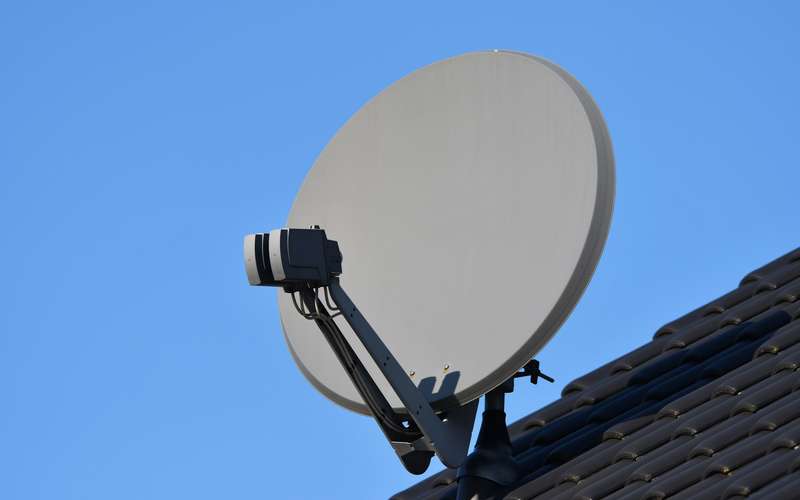
A rooftop satellite dish. Stock photo: Adobe Stock, not High Desert equipment. Photo credits
The short answer
Satellite is the service of last resort that actually reaches nearly everywhere, and it has improved. Where a tower can see your roof, the shorter path is the larger difference. Only an address check can tell you which situation you are in.
| Item | Fixed wireless (High Desert) | Satellite (HughesNet, Viasat, Starlink) | Source (date) |
|---|---|---|---|
| Published prices (read 2026-10-15) | Bronze $50, Silver $75, Gold $99 a month (High Desert) | HughesNet from $39.99 for 12 months; Viasat from $39.99 for 12 months then $69.99; Starlink from $55 | hdiss.net; hughesnet.com; viasat.com/home-internet/plans; starlink.com (read 2026-10-15) |
| Price after the first year | Bronze, Silver and Gold stay at $50, $75 and $99 a month; no promotional period | HughesNet: “Plans starting at $39.99/mo. for 12 months”; Viasat Essentials $39.99 for 12 months, then $69.99; Unleashed $69.99 then $99.99; Starlink: same card prices | hdiss.net; hughesnet.com/home-satellite-internet-plans; viasat.com/home-internet/plans; starlink.com (read 2026-10-15) |
| Equipment to buy | Nothing; antenna, radio, power supply and injector stay High Desert's and are repaired or replaced if they fail | Viasat: $15 a month equipment lease on every plan, not covered by the promotion; HughesNet: lease or purchase, prices in the order flow; Starlink: kit sold separately, price after an address | HDISS Service Agreement V 1.12; viasat.com/home-internet/plans; hughesnet.com/faq; starlink.com (read 2026-10-15) |
| Contract | None (High Desert's claim); two weeks notice and the equipment back | Viasat: “no contract or a 24-month minimum service term” depending on plan; HughesNet: term in the order flow, not on the static pages; Starlink: 30-day trial with refund | HDISS Service Agreement V 1.12; viasat.com/home-internet; hughesnet.com; starlink.com (read 2026-10-15) |
| Installation | A technician confirms the path and installs (High Desert) | HughesNet and Viasat: professional install; Starlink: kit you connect yourself | HDISS Service Agreement V 1.12; hughesnet.com/faq; viasat.com; starlink.com (read 2026-10-15) |
| Where the signal goes | From an antenna on the home to a tower, then onto the provider's network | From a dish to a satellite in orbit and back down to a ground station | hdiss.net FAQ; NASA Earth Observatory (read 2026-10-15) |
| Distance | A link of "up to about 40 miles" is High Desert's own published figure | Geostationary orbit is "about 36,000 kilometers from Earth's surface" (NASA); the FCC describes a round trip of approximately 44,500 miles | hdiss.net FAQ; NASA Earth Observatory; FCC MBA Eighth Report (read 2026-10-15) |
| Delay (FCC) | The FCC's Measuring Broadband America reports do not test tower-based providers | Median latencies of 594 to 612 ms for satellite broadband against 12 to 37 ms for terrestrial services (FCC, 2018 report, geostationary) | FCC Measuring Broadband America, Eighth Report (2018, geostationary) (read 2026-10-15) |
| What it needs | A clear path from the roof to the tower | A clear view of the sky | hdiss.net FAQ; broadbandnow.com/Fixed-Wireless description (read 2026-10-15) |
| Data rules | Data transfer limit per plan, $1 per GB over (High Desert agreement) | HughesNet: Priority Data then slower Standard Data; Viasat: 150 GB high-speed on Essentials; Starlink: data labeled Unlimited (each its own words) | HDISS Service Agreement V 1.12; hughesnet.com/plans; viasat.com/home-internet/plans; starlink.com (read 2026-10-15) |
Where a tower can see your roof, fixed wireless from High Desert is the better choice: a hop of a few miles instead of a trip to orbit, no kit to buy, a technician on the roof, and a price that does not step up after a promotional year.
Fixed wireless facts are High Desert Internet Services' own published plan cards (hdiss.net). Satellite facts are from its own website as read on 2026-10-15, science.nasa.gov/earth/earth-observatory/catalog-of-earth-sa. Every speed on both sides is up to. Nothing here is a promise of availability at any address.
Fixed wireless suits you when
- A tower can see your roof, even if your sky view is poor.
- You use video calls, remote desktop or online games that react to delay.
- You want a local company and a technician visit.
- You want a plan price that does not change after a first year.
Satellite suits you when
- No tower, cable or fiber reaches your road.
- You have a wide open view of the sky, to the south especially for a geostationary dish.
- You want a service you can order today.
- You need internet at a second property out of range of towers.

Local crew
Our towers are a drive away, and we make the drive.
Starlink's satellites orbit about 340 miles up (the FCC authorised them at 540 to 570 km, Order FCC 21-48, April 27, 2021). Our towers sit on Northern Nevada ridges, and when one needs fuel or a repair in a snowstorm, a High Desert crew drives up to it. Before anything is installed, a technician looks at the path from the tower to your roof.
Check my addressBoth are wireless and both reach places where cable and fiber do not, so they get lumped together. The physics is different, and so are the practical questions a homeowner has to answer. The figures below come from NASA, the FCC and the providers' own pages, read on October 15, 2026.
Why do people switch to High Desert from satellite?
The reasons are the same whether the dish is geostationary or low-earth-orbit; each one below is the satellite company's own published term, read on October 15, 2026.
- The trip is shorter. A High Desert link is a tower to your roof, up to about 40 miles in the company's words. A geostationary signal travels approximately 44,500 miles out and back (FCC), and the FCC measured 594 to 612 ms of delay for that service in 2018 against 12 to 37 ms for terrestrial services.
- Nothing to lease or buy. Viasat charges a $15 a month equipment lease on every plan; Starlink sells its kit separately; HughesNet prices the dish in the order flow. High Desert's equipment stays High Desert's.
- No promotional year. Viasat Essentials is $39.99 a month for 12 months and then $69.99 (read 10/15/26); HughesNet's “starting at” price is for 12 months. High Desert's three prices do not step up.
- No minimum term. Viasat says “no contract or a 24-month minimum service term” depending on the plan. High Desert says no contracts, and the agreement asks for two weeks notice.
- A technician who knows the ridge. The person who installs a High Desert antenna checks the path from a local tower first. A satellite dish is aimed at the sky, which works nearly anywhere and also means the provider is nowhere near.
Satellite wins on reach and, for Starlink, on data: it labels its data Unlimited, while HughesNet and Viasat sell a priority or high-speed allowance and then slower data, and High Desert sets a transfer limit per plan with $1 per GB over it. If no tower can see your roof, satellite is the service that reaches you, and this site says so. Where a tower can, ask for the limit on your plan and compare it with the usage your dish account shows. The three-way table is on why people switch to High Desert.
A Starlink alternative in Northern Nevada, and a HughesNet and Viasat one
Fixed wireless is the ground-based alternative to every dish. It needs what a dish does not, a clear path to a tower, and gives what a dish cannot: a local installer, equipment that stays the provider's, and no orbit in the round trip. The address check tells you which situation your roof is in.
How far does each signal travel?
A fixed wireless link goes from an antenna on your home to a tower, in a straight line. High Desert's own FAQ describes links of up to about 40 miles, and many homes are far closer than that. From the tower, the traffic enters the provider's network and the wider internet by fiber or microwave links.
A geostationary satellite sits at an altitude of about 36,000 kilometers, roughly 22,000 miles, according to NASA's Earth Observatory. A request goes up, comes down to a ground station, and the answer makes the same trip. The FCC describes the round trip as approximately 44,500 miles. Low-earth-orbit satellites, such as those Starlink uses, orbit far closer to Earth than geostationary ones, which is the main reason their delay is lower.
What does that do to delay?
The FCC's Measuring Broadband America report of 2018 measured median latencies of 594 to 612 ms for satellite broadband, and 12 to 37 ms for terrestrial services, and said the higher delay of geostationary service may impair highly interactive applications. That figure is for geostationary satellites as a group. Starlink, as a low-earth-orbit service, publishes no latency figure on the pages read, so this page prints none.
The FCC does not test tower-based fixed wireless providers in those reports, so no neutral figure exists for High Desert or its peers. The full explanation, with the sentence High Desert publishes about its own system, is on the latency explainer.
What about weather?
Any radio signal, on a tower link or a satellite link, can be weakened by heavy rain, wet snow on an antenna or a dish, or very thick wet foliage in the path. How much depends on the frequency, the distance and the equipment, which is why no honest provider promises that weather never matters. Neither technology is immune, and neither is helpless. The guide on weather and a wireless link goes deeper, and the weather and reliability FAQ collects the common questions.
How are they installed?
For a tower link, a technician visits, confirms that the roof or a mast sees the tower, mounts the antenna and runs a cable to a power injector. The agreement says payment on install day is a labor charge plus a prorated month, and the amounts are not published. For satellite, HughesNet and Viasat describe professional installation, and Starlink offers a kit you connect yourself on some plans and a free professional installation on others. See installation for the High Desert visit.
Which should I check first?
Check the one that costs nothing to ask. The address check sends the address to a person, who looks at the path from the nearest tower and calls you back. If a tower can see you, you have a choice. If not, the satellite pages on this site, Starlink, HughesNet and Viasat, set out what each publishes.
What does the FCC's December 2025 data say about satellite here?
In the FCC Broadband Data Collection as of December 31, 2025 (files read October 16, 2026), Viasat, HughesNet and Starlink each filed every broadband serviceable location in all six counties, 243,958 locations in total. Viasat's top filed tier is up to 100 Mbps down and up to 4 Mbps up, HughesNet's up to 50 Mbps down (up to 100 in Churchill County), and Starlink's up to 280 Mbps down and up to 30 Mbps up.
The FCC's low-latency flag is off on every Viasat and HughesNet row and on for Starlink's, which is how the agency separates geostationary satellites from low-orbit ones. Locations with no land-based filing at 25/3 or better, where the map shows satellite only, number 997 across the six counties, most of them in Churchill County (765). A listed location is the provider's claim about a building, not a customer.
Sources
- science.nasa.gov/earth/earth-observatory/catalog-of-earth-satellite-orbits (NASA, read 2026-10-15)
- fcc.gov/reports-research/reports/measuring-broadband-america/measuring-fixed-broadband-eig (FCC, 594 to 612 ms)
- broadbandnow.com/Fixed-Wireless (description of direct line of sight, read 2026-10-15)
- hdiss.net/ (High Desert FAQ wording, read 2026-10-15)
- viasat.com/home-internet/plans/ (Viasat plans, lease and promo terms, read 2026-10-15)
- hughesnet.com/home-satellite-internet-plans (HughesNet price wording, read 2026-10-15)
- starlink.com/ (Starlink cards, read 2026-10-15)
- broadbandmap.fcc.gov/data-download/nationwide-data (FCC Broadband Data Collection, fixed broadband availability as of December 31, 2025, Nevada files dated October 13, 2026, read 2026-10-16)
Talk to a person
- Call 775-575-9593 775-391-5660 Open 9-5 every day
- Email info@hdiss.net
Related
- Geostationary vs low-earth-orbit satellite vs a tower hop
- Is fixed wireless the same as satellite?
- Wind, snow, heat and smoke: what weather does and does not do to a wireless link
- Weather and reliability: questions and answers
- Switching from satellite internet
- Why people switch to High Desert
- High Desert vs Starlink
Local since 2002
Fixed wireless from towers in Northern Nevada. Three plans, no contracts, local support, 4.8 on Google from 36 reviews.
About High DesertSheet 02 / Plans
High Desert's three plans
$50 a month
Up to 500 Mbps down Up to 200 Mbps up
Runs a household: a 4K TV, a video call and a game at the same time, with room left over.
Check my address$75 a month
Up to 800 Mbps down Up to 200 Mbps up
More headroom: a full house online at once, several 4K TVs, work from home and big downloads.
Check my address$99 a month
Up to 1 Gig down Up to 200 Mbps up
The most headroom we sell: large households, a home office, cameras, backups and everything else at once.
Check my addressEvery speed is an up-to figure. What you see depends on the path from the tower to your roof, how many people are online and your Wi-Fi router. Each plan has a data transfer limit; ask us for yours at info@hdiss.net.
Ask about 1 Gig / 1 Gig.
Our ultra-low-latency service with upload as fast as download, in some areas. Check your address and tick "Ask about 1 Gig / 1 Gig" and we will tell you if your address can get it. About the 1 Gig / 1 Gig service.
Prices and speeds as published by High Desert Internet Services (hdiss.net, read 10/15/26). "Runs" lines use the FCC Household Broadband Guide and Broadband Speed Guide (fcc.gov), which the FCC calls rough guidelines; every High Desert plan is above the FCC's highest household band of more than 25 Mbps. Not sure which plan? Use the plan picker.
Is fixed wireless the same as satellite?
No. Fixed wireless uses a tower on the ground. Satellite uses a spacecraft in orbit.
Which has less delay?
The FCC measured satellite broadband at 594 to 612 ms against 12 to 37 ms for terrestrial services in 2018, for geostationary service as a group.
Does weather affect both?
Heavy rain and wet snow can weaken any radio link. See the weather guide.
Is fixed wireless a Starlink alternative in Northern Nevada?
Yes, where a tower can see the roof. High Desert's fixed wireless is $50, $75 or $99 a month, no contract, no kit to buy, installed by a technician. Where no tower can see you, Starlink's open sky is the requirement you can meet.
Why switch from a dish to a tower?
Shorter trip, no kit or lease, no promotional year, no minimum term and a local installer. The satellite companies publish each of those terms on their own sites (read 10/15/26).
Open 9-5 every day
Can we reach your roof?
Send the address. A person looks at the path from our nearest tower and calls you back: clear, not clear, or we need to look at it from your roof.
- No contracts
- Local support
- 4.8 on Google (36 reviews)
- Since 2002
High Desert Internet Services, PO Box 11353, Reno NV 89510. info@hdiss.net