
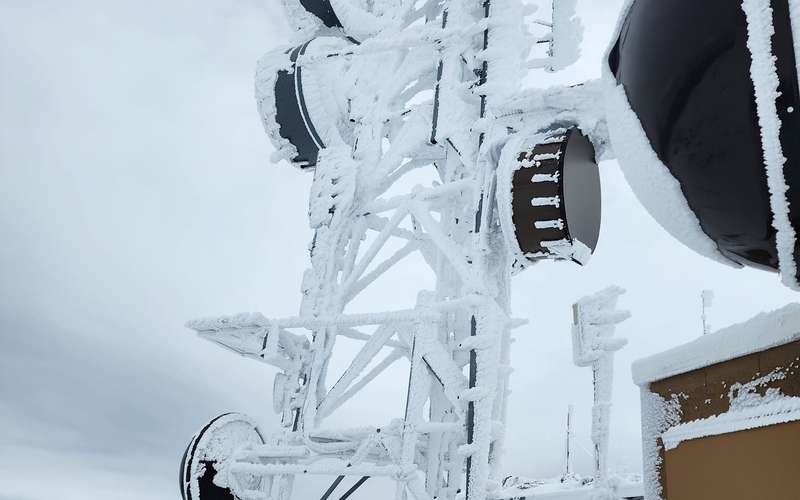
Northern Nevada gets all of it: high-desert wind, heavy Sierra snow, triple-digit summer heat and, in some years, weeks of wildfire smoke. People who are thinking about fixed wireless ask the fair question of whether any of that gets in the way. The honest answer has parts. Some effects are real, some are small, and some depend on details no one can see from a desk. This guide keeps to general principles and names what is not known.
Takeaways
- A tower link needs a clear path. Weather that changes the path, such as snow-laden branches, matters more than weather in the air.
- Power matters. The indoor equipment needs household power, so an outage at your house stops it.
- No page on this site promises uninterrupted service in any weather. Customers describe their own experience in reviews.
Does weather affect fixed wireless?
It can. Radio travels in a straight line from the antenna on your building to the antenna on the tower, as BroadbandNow's fixed wireless guide puts it: the two must have a direct line of sight, and the signal cannot pass through or around minor barriers. Anything that moves into that line can change the result. Most of what weather does to a link comes down to that.
What do wind and snow do?
Wind moves trees and branches, and it can also flex a mast or a mount, so an antenna that is aimed carefully on a calm day can be a little off after a hard storm. Snow loads branches until they droop into the path, and then they spring back when the snow melts. A tree that never touched the link in July can sit in it in January. If you have trees near the path, a technician looking at the site in winter learns something that a summer visit cannot, which is one reason to mention trees when you call.
Neither is unique to wireless. Wind and snow bring down phone lines and cable too. The difference is the path: a wireless link has no buried or strung line between the tower and your house.
How often does Northern Nevada actually get high wind and heavy snow?
NOAA's Storm Events Database gives real counts. From 2015 through 2025 the National Weather Service in Reno logged 116 high wind episodes for the Greater Reno/Carson City/Minden Area zone, 44 for Western Nevada Basin and Range (Fernley and Fallon country), 60 for Mineral/Southern Lyon and 91 for the Greater Lake Tahoe Area. The busiest single years were 2024 in the Reno-Carson-Minden zone (23 episodes) and 2023 in the basin zone (12) (NOAA NCEI Storm Events Database, detail files pulled October 16, 2026).
The strongest gusts in those rows reached 109 knots (about 125 mph) in the Reno-Carson-Minden zone (November 2017) and 118 knots (about 136 mph) at Tahoe (February 2025). Heavy snow is mostly a Sierra story: 95 heavy snow episodes at Tahoe, 20 of them in 2023, against 44 in the Reno-Carson-Minden zone. Wildfire rows number 10 for the valley zone over the eleven years, and the database logs smoke rarely (one dense smoke row, in 2022), so smoke days are undercounted there. These are weather records, not a measure of anyone's service.
What does heat do?
Outdoor equipment is built to live outdoors, and the antenna and radio sit in sun all day in a Nevada summer. Heat is more likely to affect indoor equipment such as a router in a closed cabinet or a garage, which is a reason to give it air. The effect of temperature on the radio link itself is not something this site can quantify, so it does not.
If you notice your router is hot to the touch, move it to a place with airflow. Our guide on where to put your router has the full list.
What about wildfire smoke?
Smoke fills the sky and the lungs, but fine particles in the air are a different thing from a solid object in the path. In general, a tower link is not stopped by haze the way it is by a hill or a stand of trees. The real risks in a fire are physical: fire near towers, power lines or your own building, and evacuations. This site cannot tell you how smoke affects any particular link, and High Desert has not published anything on it.
What matters more than the weather?
Power. The antenna and radio are fed through a power supply and an injector, both supplied by the company under its service agreement, and they need electricity at your house. If power fails at your home, the link goes down with the router. Our guide on NV Energy outages and staying online covers backup options, and the one on surges, outages, UPS and generators covers protecting equipment.
What do customers say?
Reviews on High Desert's Google listing from May 2025 describe outages as rare. One customer, T B., wrote that outages are few and far between. Another, Karin K., wrote that in the event of any down time the company has always responded to her calls very quickly. Those are customers' own words, not a promise that your service will behave the same way.
What should I do after a storm?
Check the easy things first. Is the power on at your house and at the indoor injector? Has the router restarted? Our outage article lists the order to check. From the ground, look for a branch lying across the cable, or a mast that looks bent. Do not climb to the roof and do not touch the antenna, the radio or the cable. The company supplies and owns that equipment and repairs or replaces failed supplied equipment under its agreement. Call 775-575-9593 and a person answers from 9 to 5 every day. A service call where no fault is found is billed at time and material rates, which is why the checks above are worth doing first.
If you are still deciding, send your address through the check form. A person looks at the path from the nearest tower to your roof and calls you back, and you can ask about trees, wind and your mounting spot then.
Sources
- broadbandnow.com/Fixed-Wireless (BroadbandNow fixed wireless guide, modified Dec 7, 2023, read 10/15/26)
- hdiss.net/terms-of-use/ (HDISS Service Agreement V 1.12, equipment, maintenance and service call sections, read 2026-10-15)
- google.com/maps (High Desert Google Business listing reviews, May 2025)
- ncei.noaa.gov/pub/data/swdi/stormevents/csvfiles/ (NOAA NCEI Storm Events Database, 2015-2025 detail files, pulled 2026-10-16)