
- Glossary
Geostationary satellite
A geostationary satellite hangs about 22,000 miles up and appears fixed in the sky, so a home dish can stay pointed at it. The long trip adds delay that tower-based service does not have.
- No contracts
- Local support
- 4.8 on Google (36 reviews)
- Since 2002
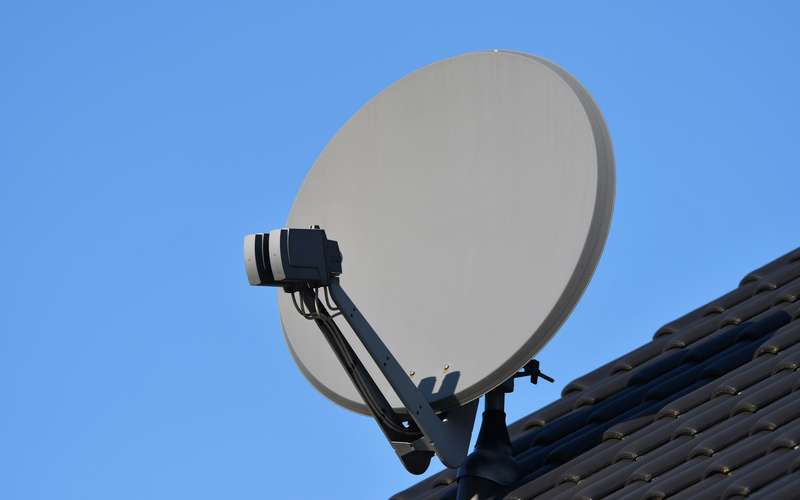
A rooftop satellite dish. Stock photo: Adobe Stock, not High Desert equipment. Photo credits
What is a geostationary satellite?
NASA's Earth Observatory catalog of satellite orbits puts geostationary orbit about 36,000 kilometers above Earth's surface, roughly 22,000 miles, directly above the equator. At that height one orbit takes a day, matching the Earth's turn. HughesNet and Viasat are the well-known home internet providers that use satellites of this kind. Because one satellite sees a wide region, this service can reach places no tower or cable does.
The same distance sets the delay. The FCC's Measuring Broadband America report (Eighth Report, 2018) found that packets travel approximately 44,500 miles from an earth station to the satellite and back, and measured median latencies of 594 ms to 612 ms for satellite services, much higher than the figures for terrestrial service. See latency.
How does it compare with a tower in Northern Nevada?
A tower link crosses miles, not tens of thousands of miles. The FCC noted that the higher latencies of geostationary service may impair the perceived quality of highly interactive applications such as calls and games. Satellite service does not need a clear path to a tower, only to the sky, which helps where hills or trees block a ground link. HughesNet's own FAQ says satellite plans are not recommended for time-sensitive applications because of a small degree of latency (read 10/15/26).
Low-earth-orbit service works differently; see low-earth-orbit satellite. High Desert publishes no latency figure of its own, so this page does not place a number on it.
What should I do about it?
List what you do online. Streaming and browsing work with delay, while video calls, remote work and games notice it. Compare prices, data policies and contract terms on each provider's own site, as the comparison pages show: HughesNet and Viasat. The wider comparison is at fixed wireless vs satellite.
If you now use a dish and want to know if a tower path reaches you, Check your address or call 775-575-9593. The guide switching from satellite covers the steps.
Sources
- science.nasa.gov/earth/earth-observatory/catalog-of-earth-satellite-orbits (NASA Earth Observatory, read 10/15/26)
- fcc.gov/reports-research/reports/measuring-broadband-america/measuring-fixed-broadband-eig (FCC, Eighth MBA Report, read 10/15/26)
- hughesnet.com/faq (HughesNet FAQ, read 10/15/26)
Talk to a person
- Call 775-575-9593 775-391-5660 Open 9-5 every day
- Email info@hdiss.net
Related terms
Local since 2002
Fixed wireless from towers in Northern Nevada. Three plans, no contracts, local support, 4.8 on Google from 36 reviews.
About High DesertOpen 9-5 every day
Can we reach your roof?
Send the address. A person looks at the path from our nearest tower and calls you back: clear, not clear, or we need to look at it from your roof.
- No contracts
- Local support
- 4.8 on Google (36 reviews)
- Since 2002
High Desert Internet Services, PO Box 11353, Reno NV 89510. info@hdiss.net